

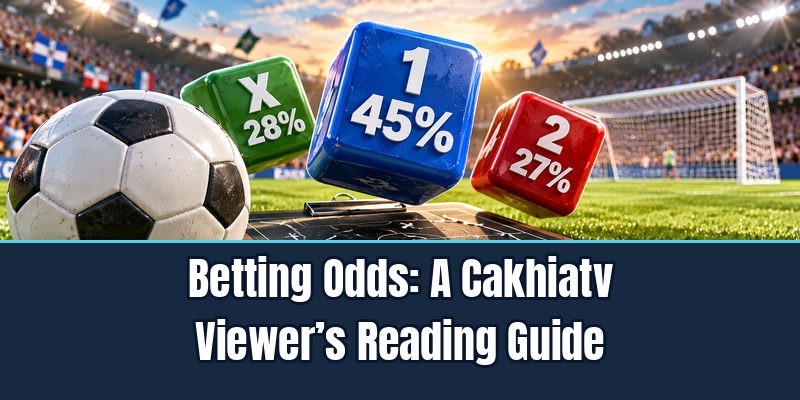
Betting odds appear frequently in football discussions, but understanding them requires more than spotting the shortest price. For Cakhiatv viewers, a basic reading guide can make pre-match information clearer without turning market expectations into a prediction of certainty. Prices express a market assessment under particular conditions and at a particular time. They can change as information and activity change. Learning what the main formats mean helps you interpret that information sensibly while keeping the football itself at the center of the experience.
Understand what betting odds actually express
Betting odds express expectations before a match
An odds display answers a market question about an event, such as which team will win. It does not describe a result that has already happened. Start by identifying the event and the format before comparing any of the numbers.
Favorites, outsiders, and implied probability
In decimal notation, a shorter price generally represents an outcome considered more likely by that market than one with a longer price. The comparison is relative. A favorite can still lose, and an outsider’s chance is not zero simply because its price is longer.
A simple way to discuss betting odds is through implied probability. For decimal prices, dividing one by the price gives a basic implied figure before accounting for the market margin. A price of 2.00 corresponds to 50 percent under that calculation. The number explains the quotation, not a verified measurement of the future.
This distinction matters in everyday football conversation. Calling a team the favorite describes its market position. Calling it certain to win makes a much stronger claim that the price cannot support.
Why the market margin matters
When the implied probabilities of all mutually exclusive outcomes are added together, the total commonly exceeds 100 percent. That excess is associated with the margin built into the quoted market. It is one reason that the numbers should not be treated as neutral probabilities without adjustment.
Reading betting odds carefully means noticing this difference rather than comparing quoted figures as though they were objective facts. You can understand what a price communicates without accepting it as a complete or unbiased forecast of the match.
Different price formats can also make comparisons look more complicated than they are. Decimal, fractional, and American notation express prices differently, so two quotations should not be compared by their visible size alone. Establish which notation is being used before drawing a conclusion about the favorite. You do not need to memorize every conversion to recognize this basic issue. Read the format explanation attached to the source, keep comparisons within the same convention where possible, and avoid mixing figures copied from unrelated displays. Clear labeling is an important part of understanding a market, not merely a visual preference.
Distinguish common football market types
Betting odds vary across different football markets
Different markets ask different questions about the same fixture. Readers should identify the conditions attached to a quotation before interpreting it. A similar-looking number can have a different meaning when the market or settlement period changes.
Match results and handicaps
A standard three-way result market concerns a home win, draw, or away win over the specified period, commonly regulation time plus added time. Extra time is not automatically included. The published conditions determine what the market covers.
Handicap markets introduce an adjustment to a team’s score for the purpose of the market. Different handicap types use different structures, so the precise line and rules matter. A basic introduction to betting odds should explain that distinction without presenting all handicaps as interchangeable.
The important reading habit is to ask what must happen for the stated outcome to count. That question is more useful than focusing on the price alone.
Goals totals and their meaning
A goals market concerns the combined number of goals relative to a stated line. For example, a half-goal line separates totals cleanly because a match cannot finish with half a goal. Other line formats can involve additional settlement conditions.
With betting odds, the line and the price belong together. Comparing two prices attached to different totals does not compare identical expectations. Read the complete quotation and the relevant rules before describing what the market appears to suggest.
Put changing betting odds into football context
Betting odds offer one view of pre-match expectations
Prices can move before kickoff for several reasons. Confirmed lineups, player availability, and new information may change expectations. Market activity can influence quotations too, so movement alone does not identify the exact cause.
Treat betting odds changes as a reason to ask questions rather than proof that someone knows the result. Check what information became available, whether the quotation is current, and whether you are comparing the same market. An old screenshot may reflect circumstances that have already changed.
Football context remains necessary. A team with a shorter price might still face a specific weakness or an unfamiliar tactical problem. Conversely, a longer price does not make every positive argument about the outsider persuasive. Market information and football analysis are related perspectives with their own limitations.
Avoid judging the quality of a match solely through its prices. A heavily favored team can be involved in a tense contest, while a balanced market does not guarantee entertainment. The appeal of viewing includes uncertainty, performance, and the story unfolding on the pitch.
Used carefully, betting odds make one part of pre-match discussion easier to understand. They should sit alongside team news and competition context rather than replace them. Knowing the vocabulary helps you recognize what is being claimed and what remains unknown.
Another useful distinction is between a price and the time at which it was recorded. A quotation from the morning and one shown shortly before kickoff may refer to different information environments. Comparing them without a timestamp can create a misleading impression of disagreement. With betting odds, note the market, the line, and the moment of the quotation before interpreting any difference. The same discipline applies when someone shares a number in a discussion without explaining its source or conditions. You do not need to act on the information to understand it. Reading it accurately simply means knowing which question the price addresses and avoiding conclusions that the quotation cannot support on its own.
Conclusion
Betting odds are informative when their format, conditions, and limits are understood. They express expectations at a moment in time, not a promise about the final whistle. Visit Cakhiatv and review Tỷ lệ kèo to read the available market information in context. Keep your attention on clear interpretation, then enjoy the match for the football that actually unfolds.
